PROBEROS
PROBEROS LF190 Sinking Inshore Slow Pitch Lures 30g-100g for Grouper
PROBEROS LF190 Sinking Inshore Slow Pitch Lures 30g-100g for Grouper
Couldn't load pickup availability
Why Choose PROBEROS? Delivery time?
Why Choose PROBEROS? Delivery time?
🚚 Fast, Free Shipping on Orders Over $100
Total estimated delivery time includes order processing time (1-5 business days) and transit time:
• Standard Shipping: 7-20 business days
• Expedited Shipping: 7-10 business days
Sit back and relax while your package is on its way!
🛡️ 30-Day Money-Back Guarantee
Get a full refund when you return your undamaged products within 30 days - for any reason. Once the item arrives back at our warehouse for inspection, the refund process will begin.
✉️ Lifetime Customer Support
We'll always be there for you.
If you have any questions or concerns, feel free to contact us at sales@proberos.com

PROBEROS LF190 Inshore Slow Pitch Lures 30g-100g
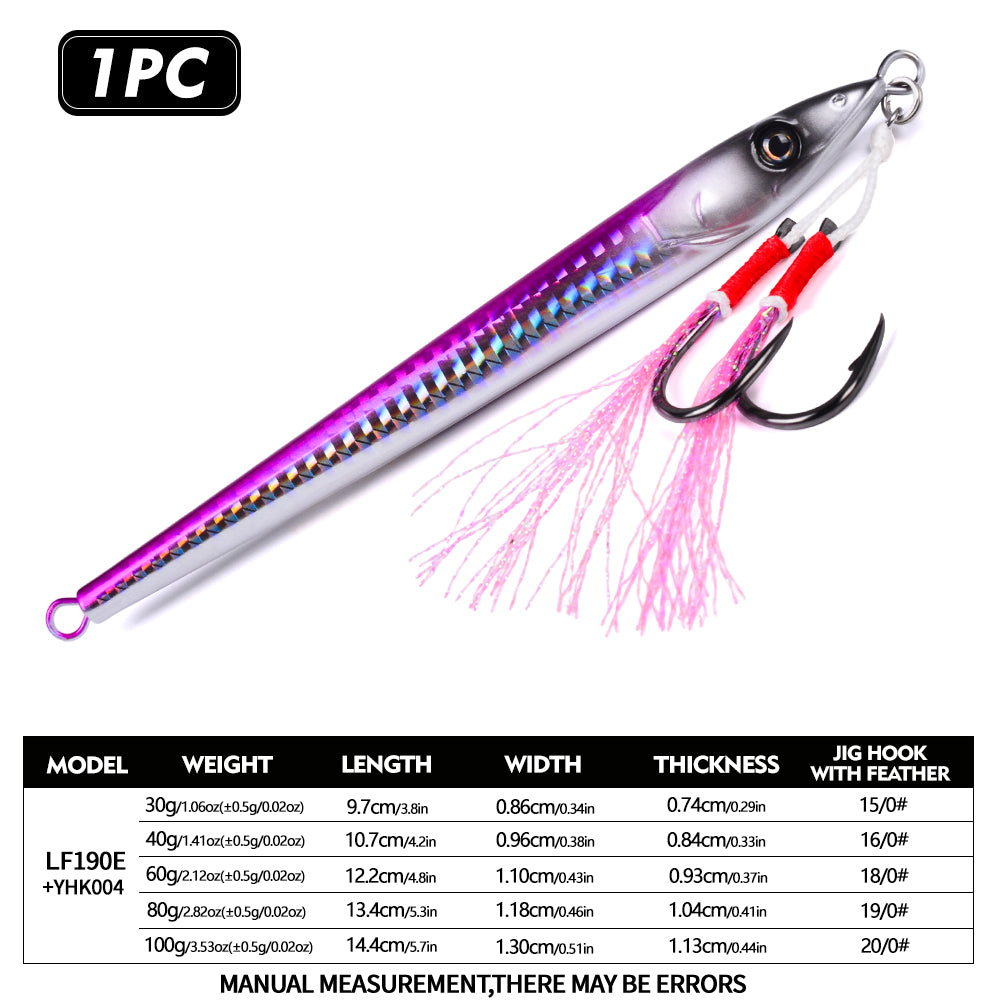
Built for slow pitch jigging in Mid-depth ground water. 5 finishes, 9.7 cm to 14.4 cm of real body length, and hook sizes matched to each weight - all of it measured on the production jig.
Laser holographic foil that flips between two faces on the drop and throws contrast in every direction, so the jig keeps working in the conditions where the fish are actually feeding. Every number in the table below is measured from the production jig, not rounded up for the listing.
Technical Specifications
Model: LF190 | Material: High Density Lead Core Body + High Carbon Steel Assist Hook with Feathers | Water: Saltwater / Offshore / Deep Sea Fishing | Colors: 5
| Weight | Ounces | Length | Hook size |
|---|---|---|---|
| 30 g | 1.06 oz | 9.7 cm | 15/0# |
| 40 g | 1.41 oz | 10.7 cm | 16/0# |
| 60 g | 2.12 oz | 12.2 cm | 18/0# |
| 80 g | 2.82 oz | 13.4 cm | 19/0# |
| 100 g | 3.53 oz | 14.4 cm | 20/0# |
Weights, lengths and hook sizes are the factory figures for this model. Smaller weights sit shorter, larger weights sit longer - pick the weight for depth and current, not for looks.
Finishes & Color Options
Available in 5 colors (A, B, C, D, E). Every color is finished with the same hard multi-layer coat, so the only thing that changes between them is visibility - exactly what you want when you are matching light conditions.
Laser holographic foil that flips between two faces on the drop and throws contrast in every direction.
Fishing Scenarios & Technique
Working range: mid-depth ground from about 20 m to 60 m. Rig the assist hook on the head ring and keep the leader light enough that the jig still flutters on the drop.
How to work it: One or two short rod pitches, then let the jig fall on a semi-slack line and hold the pause. Most bites come on the fall, so keep a finger on the line and strike only when weight loads up.
Tackle: PE 1.5-2.5 braid, 30-50 lb leader, a 6 ft 6 in - 7 ft 2 in jigging rod. Match the weight to the drift: if the line streams away at a sharp angle, step up one weight class before you change anything else.
Typical sessions: inshore and light offshore jigging anglers fishing reef edges and bait schools - drift fishing over structure, slow vertical work under the boat, or casting where the bottom shallows out.
Regional Playbook
USA & Canada
Worked over reefs, wrecks and bait balls - mid-depth ground from about 20 m to 60 m. Local crews fish this weight class in the tuna and yellowtail zone, so match the jig to the current rather than to the depth number alone.
Australia & New Zealand
Drifting gravel, sand and reef edges in mid-depth ground from about 20 m to 60 m is the standard play here. Keep the line near vertical, stay in contact with the bottom and re-drop the moment the drift runs out - grouper, yellowtail kingfish, samson fish are caught on the lift as often as on the fall.
Japan
Offshore and bay jigging - mid-depth ground from about 20 m to 60 m. Japanese crews name the targets Hata / Ako, Buri / Inada / Warasa, Hiramasa / Kanpachi, and the same jig covers both the mid-water fish and the bottom fish that sit under them.
Korea
Boat jigging on the drift - mid-depth ground from about 20 m to 60 m. Korean anglers work the same water for Bari, Bangeo, Bushiri, with a slow steady retrieve and the rod tip low to keep the jig in the strike zone.
Rigging & Hardware
What you get: sold in two configurations - blank jig body without hook, or pre-fitted with the hand-tied feather assist hook (hook sizes 15/0# / 16/0# / 18/0# / 19/0# / 20/0#).
Every PROBEROS assist hook set is hand-tied: high-strength PE braiding knotted onto the hook shank, then 80-100 tight wraps of fine thread, then locked with glue. Flash fibres are bound in with the wraps so the hook set glints and moves in the water. Each set is rated above 150 lb - if a hook straightens or snaps, the tie itself will not let go of the shank.
Check the tie and the hook point after every fish, and replace the set if the wraps have been cut. A spare set in the boat is cheaper than the fish you lose.
FAQ
What weights does the LF190 come in?
30 g, 40 g, 60 g, 80 g, 100 g (1.06-3.53 oz). Lengths run 9.7 cm to 14.4 cm, so you can step from mid-depth ground into deep water without changing the jig family.
Does it come rigged?
Sold in two configurations - blank jig body without hook, or pre-fitted with the hand-tied feather assist hook (hook sizes 15/0# / 16/0# / 18/0# / 19/0# / 20/0#). Every PROBEROS hand-tied hook set is knotted and glued, never crimped.
How should I work it?
Mid-depth ground from about 20 m to 60 m. Use one or two short rod pitches, then let the jig fall on a semi-slack line and hold the pause. Most bites come on the fall, so keep a finger on the line and strike only when weight loads up.
What will it catch?
Grouper, Kingfish, Amberjack, Tuna, Seabass and more. The hook sizes are matched to the weight, so grouper and kingfish are both realistic targets.
What tackle do I need?
PE 1.5-2.5 braid, 30-50 lb leader, a 6 ft 6 in - 7 ft 2 in jigging rod. Mid-depth ground from about 20 m to 60 m is the working range for this weight.
Care
Rinse the jig and the hook set in fresh water after every trip, dry them before storage, and touch up hook points with a file. Salt left on a tied assist hook is what kills the wraps first.